


Companies have three main options to choose from when it comes to implementing an ecommerce site:
- Custom build the e-commerce website
- Choose an e-commerce packaged solution
- Go with a hosted ecommerce solution
Each of those options has advantages and disadvantages. And while there are no correct an absolute answers in this area, there are some common approaches to select the best solution that will coincide with the business’s mission and objectives. A solution that works well with one business model might not be the best option for a different one. You also should consider the short and long-term costs associated with each of these options. The combination of benefits and costs should influence your final decision of which approach to choose.
E-commerce platform selection: what factors should you evaluate?
Here is a list of factors you should consider when evaluating the different options you have for e-commerce implementations. This is by no means a final list, but should provide a good starting point that can be further molded to your specific situation.
1. Out of the box features
Both hosted ecommerce solutions as well as ecommerce packages come with different features based on the markets they cater to. You can and should expect to have standard ecommerce features such as cataloging, checkout, and credit card authorization modules to be included as part of the standard feature set. However, there might be specific requirements that you need to investigate further in your own situation. This starts with understanding your own unique requirements and then validating these requirements against the features offered by the different solutions.
2. Time-to-market
How long does it take to design, build, test, and release the solution? The timeline will vary based on the complexity of your requirements. I worry a lot when someone gives a blanket answer to timeline questions around e-commerce implementation. How can anyone predict that it will take 3 months to finish an ecommerce implementation without knowing the business requirements behind it? Yet many sales people are willing to jump the gun and give a standard answer. Hosted e-commerce solutions provide the fastest time to market for a company. Custom implementations on the other hand will take the longest time to complete. Finally, choosing an e-commerce package usually falls between the two.
3. Ease of migration from current systems to new platform
You currently have your data, such as products and customer information, stored in one system and you “may” need to migrate some of that data into the new ecommerce site. Some e-commerce packaged solutions will provide out-of-the-box import functionality that simplifies the process of moving data between the old system and the new e-commerce website. On the other hand, things might be a little more complicated with a hosted ecommerce solution. A custom implementation might eliminate the need for data transfer all together since the custom built system might access your data directly.
4. Ease of integration with external and internal systems
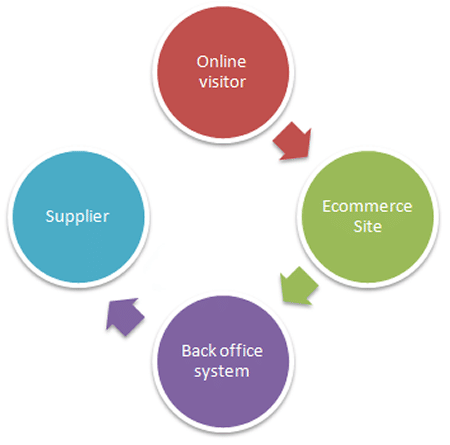 Assuming that your e-commerce website will have to integrate with external systems, how easy would that be between the different options? The answer to that depends on the type and number of external systems you have to communicate with. External systems include the back end office systems, CRM applications, accounting systems, and credit card processing systems. Many enterprise e-commerce packages come with built-in mechanisms to communicate with a variety of external systems which provide easy integration between the new e-commerce website and the external system. Hosted e-commerce solutions do not perform as well in the area of external integration. A custom solution will fall somewhere in between.
5. Scalability issues
How easy it is to scale an e-commerce website upwards or downwards should be another area of consideration when selecting the solution to go with. While this is usually more a hardware than a software question, there are times when the software is not able to handle large numbers of concurrent users at the same time. You need to make sure that your custom development or packaged solution will support a multi server environment (clustered server setup).
6. Ease of customization (branding, change of look and feel, etc.)
This is an important question when it comes to choosing an e-commerce prepackage or a hosted ecommerce solution. Will it be simple to customize the look and feel of your website? You need to have the ability to brand your website and change its look and feel when necessary. Even more important is the ability to change the flow of the site easily. This is not an issue in the case of a custom solution since the application is built specifically to meet your own requirements. Most e-commerce packages will allow a certain level of control over the look and flow of the application. Yet you should expect to pay a decent amount of money to customize these packages. Hosted e-commerce packages on the other hand are very limiting when it comes to major changes of the application appearance or flow.
7. Upgrade challenges with an ecommerce package
Will you be able to move from a one version of software to the next version? How much money, time and effort will you be expected to invest when completing an upgrade? This is usually a problem with custom implementation as well as well as ecommerce packages. Hosted ecommerce solutions usually handle all upgrade issues without requiring you to do any work. As a general rule of thumb, the more complex the ecommerce package, the more time it will require to upgrade from one version to the next. If you have customized any ecommerce packages to match your own requirements, expect to spend more time during an upgrade. Upgrading your own custom code is required sometimes when a certain component of your code is obsolete or newer and better versions are released.
We will continue the remaining 6 elements in the next blog!