Conversion Rate Optimization Blog

About the Invesp Blog

This blog is brought to you by the team at Invesp, a conversion optimization company.


Meet the authors of the invesp blog: Ayat, and Khalid.

Subscribe

RSS Subscribe via RSS Feed

Or, receive weekly updates by email:

Landing page optimization

Does your PPC campaign need help?
Invesp offers
landing page
optimization

By Samantha Gonzales on January 27, 2009 5:25 am

iStock_000004159256XSmall

Got a huge catalogue of products and no desire to match items to individual prospects?

You’re probably going to hate this post.

But if you heed some of the advice within it, you may find yourself with increased conversions.

Business owners who fit the above description usually have very set ways of thinking. Operating under the assumption that "more is more” is one of the hallmarks of their minds.

Ever hear of the idea that "less is more”? Yes, it may be cliche, but it can be central to business owners’ selling success . Focusing on offering less can actually bring in more conversions and sales.

Sound crazy? It’s not. It can all be traced back to the “paradox of choice.”


First, let’s define what the paradox of choice is…

As Daniel Scocco succinctly summarizes, the paradox of choice:

…states that increasing the number of choices will improve the user experience, but only until a certain point. After that point the added choices will not only be indifferent to the user, but they might also become counterproductive.

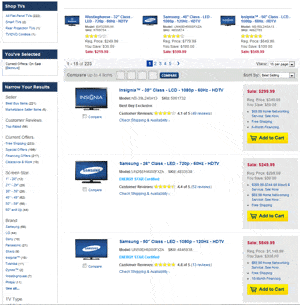
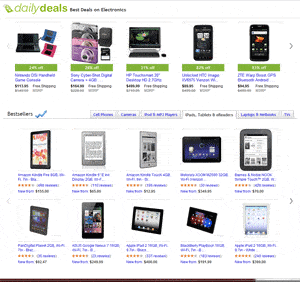
You may be asking how this relates to your business. If you offer a lot of related products on your website, you’re giving your prospects the extra task of deciding on a product when you should be giving them only one thing to do- buying the one product that best suits them.

Doing anything else may end up driving your prospects into the arms of a competitor.

How?

Because by offering a multitude of equally viable solutions to their very specific problem, you’re imposing a decision on them- one that needs to be made very carefully.

And many prospects don’t want to have to deal with that problem on top of their existing one.

When you do that, you’re effectively driving them off of your website because you’re giving them the assignments of having to research and compare before pressing the "Buy Now" button. If you require that a prospect log off of your website and go through the trouble of opening up a search engine and researching products that you offer, can you really expect them to return to your website to buy?

Here’s the harsh truth: prospects are prospects- they have no loyalty to you. They’re simply considering buying from you. If you offer them a reason to second-guess purchasing from you, they’ll take it. You can bet that your potential business will then become your competitors’.

Prospects appreciate business owners who are confident in their ability to provide solutions. They want to see you give them the one solution they’re searching for, hassle-free. That type of confidence and straightforwardness is contagious. It can encourages them to trust you and buy from you.

But what’s the answer if, by the nature of your business, you offer numerous products? What if you take pride in your extensive inventory?

I would suggest that you start tailoring search results or landing pages to very specific target markets, if you haven’t already. It’s not about creating a page with lots of appealing items on it and hoping prospects will bite. No, not all. As Rich McIver points out, an abundance of differing calls-to-action can result in them doing nothing at all.

Instead, David Cross suggests presenting a maximum of three separate choices. Providing one option is the preferred way to go. Coupled with an exceptionally easy buying process, offering a single specifically-tailored and optimized solution to a prospect’s problem is one of the best ways to increase conversions. It’s just that simple. As simple as 1, 2 and 3, actually.

If you find that some method of comparison has to be anticipated, make it easy for prospects to conduct comparisons within your website. The last thing you want is for prospects to leave your website and come across a competitor who has an easier buying process and lower-priced products.

Want a final tip?

Mike at Mind Valley Labs suggests that business owners start viewing their websites as a "guides" rather than "catalogues." To put it simply, guides lead the way to a specific destination- in this case, it’s a sale. Catalogues just present product choices and give prospects the option to buy. You can see why the latter is totally unacceptable. Approaching your website as a guide can position yourself as the go-to source for products amongst prospects. You may even end up a leader in you industry. No GPS needed.

Share and Enjoy:
  • StumbleUpon
  • del.icio.us
  • Reddit
  • Propeller
  • Sphinn
If you enjoyed this post, make sure you subscribe to my RSS feed!

If you enjoyed this post, please consider subscribing to the Invesp blog feed
to have future articles delivered to your feed reader.

Or, receive weekly updates by email:

5 Responses to “ How The Paradox of Choice Can Lead to Lower Conversions”

 
Pat Testers Says -- January 28th, 2009 at 1:18 am

Awesome post. I was wondering how you think express checkout features. Would also add “the removal of distractions from the checkout process”.

 
Bob Firestone Says -- January 28th, 2009 at 2:41 am

This is great advice. Every extra choice is a potential roadblock that can kill the sale. My dad (a career sales guy) told me in closing a sale two choices are good; more than two is just too many.

 
Charles Says -- February 8th, 2009 at 4:11 am

I agree. Most people really don’t know what they want. That’s why salesmen have a job. Giving them to many choices confuses them and they could just possibly walk away.

 
website conversions Says -- February 8th, 2009 at 11:32 pm

Yes i know what you mean, I found a tool on http://www.eziseo.com that will perform a traffic website conversion calculation and tell you your ROI for your volume of visitors.

 
Righteous Marketing » Blog Archive » How to Craft an Irresistible Call to Action for Your Landing Pages (Guest Post) Says -- April 7th, 2010 at 8:52 am

[...] A lot of companies approach their landing page and call to action with the more is more philosophy. They believe that offering customers with a lot of choices increases the chances of them finding an option they like and taking action. The truth is choice usually leads to lower conversions. [...]