

Disclaimer: This section is a TL;DR of the main article and it’s for you if you’re not interested in reading the whole article. On the other hand, if you want to read the full blog, just scroll down and you’ll see the introduction.
- Conversion rate optimization is a science.
- As a science, this means you should have a process and system that allows you to reproduce and increase in conversion on your website.
- We created a conversion framework that provides anyone interested in optimization with a specific methodology to produce consistent results.
Why You Need A Conversion Rate Optimization Framework.
- We started Invesp in 2006 with a simple goal: to create usable, visitor-captivating websites that generate more orders for our clients.
- Over the years, some clients we talked to felt that conversion optimization involved random guessing, a lot of finger crossing, and prayers. We quickly corrected that misunderstanding, by proving a scientific process to achieve the desired results.
- Throughout my experience as the software architect for large companies such as Motorola, GoToMeeting, etc there was one constant theme. It does not matter how much you love your website design. The visitor is always the real judge.
Invesp’s Conversion Framework
- The conversion framework was developed in 2007. We knew we had to follow a proven methodology that would generate consistent results for clients.
- The conversion framework is built around 7 principles. Trust and confidence (T), FUDs (F), incentives (I), engagement (E), visitor persona temperament (P), the buying stage of visitors when they come to the site (B), the sale complexity (S).
- We like to break down the factors in the Conversion Framework into two different groups: website-centric and visitor-centric factors.
- As you delve deep into CRO, you’ll discover that there are different techniques you can use to accommodate and enhance website-centric factors.
- Visitor-centric factors relate to the website visitors’ mindset and the nature of the purchase.
The Conversion Rate Uplift Formula
- The Conversion Framework Uplift Formula translates the different factors of the Conversion Framework into a formula you can apply to different pages on your website.
- CRU = {3T-(2F-(I+E))] *B}^ (P * C). This is not a mathematical formula.
- This formula rather attempts to decipher human behavior on the web, recognizing which factors persuade visitors to convert on a website as well as which ones make them abandon the site. (more on this in its section)
Using The Conversion Framework During A CRO Program
- To apply the conversion framework during a CRO project, you go through several steps.
- At a very high level, these steps are; Conducting heuristic analysis, conducting qualitative analysis, conducting quantitative analysis, conducting competitive analysis, creating a conversion roadmap, identifying problems, using the conversion framework for assessing problems, prioritizing problems on the page, creating a hypothesis, create new designs, conduct A/B testing, conduct post-test analysis.
Here’s A Longer And More Detailed Version Of The Article.
Conversion rate optimization is a science.
This means you should be able to reproduce a process, step by step, through a time-tested system, to achieve the increase in conversions you aspire for your website.
Sounds good, right? That is why we created the Conversion Framework.
The goal of the Conversion Framework is to remove the guesswork from the conversion optimization process. It provides anyone interested in optimization with a specific methodology to produce consistent results.
In the following chapters of this guide, you will discover the Conversion Framework and its different elements. This framework is the process we developed and deployed on hundreds of websites and thousands of successful A/B and multivariate tests to help increase conversion rates.
The framework puts the buyers at the heart of your optimization effort.
It forces you to think of the buyers’ needs, wants, motivations, and fears. By focusing on the buyers, you will ultimately persuade more of them to become your customers.
Why do you need a framework?
We started our conversion optimization firm in 2006 with a simple goal: to create usable, visitor-captivating websites that generate more orders for our clients.
No matter what you are consulting on, there are specific criteria that can set apart the $50/hour and the $750/hour consultant. The quality of work and insights you provide your clients will determine your level.
Over the years, some clients we talked to felt that conversion optimization involved random guessing, a lot of finger crossing, and prayers. We quickly corrected that misunderstanding, by proving a scientific process to achieve the desired results.
This is not unique to CRO. If you want to succeed in any type of business venture, you must follow a framework and a process. By doing so, you ensure consistent offers and outputs to your clients. Consistency builds your reputation in the marketplace and addresses one of your client’s main needs.
We, as humans, like consistency. Why do people prefer to go to McDonald’s or Starbucks everywhere? Because, as we walk into a McDonald’s, we know exactly what we will get. There are no surprises.
Before we started doing conversion optimization, I was the software architect for large companies, including American Express, Motorola, and GoToMeeting, to name a few.
Throughout my experience, there was one constant theme. It does not matter how much money you invest in a website. It does not matter how much you love your website design. The visitor is always the real judge.
Ultimately, all marketing is about the visitor, but it is striking to see that time and time again, the visitor and target market are often forgotten or misunderstood.
In every conversion optimization project we worked on, in the past twelve years, for large corporations (eBay, 3M, O’ Reilly, Ericson, Special Olympics and many more) and smaller companies, our goal was to come up with both a methodology and a process for understanding the human behavior and designing for it.
This is the complexity as well as the beauty of conversion optimization: it’s a continuous learning process that studies human behavior and must be evolved accordingly, whilst giving you specific accuracy in measuring the impact of your work, as opposed to other types of marketing.
The Conversion Framework
Since the early days of Invesp, we knew we had to follow a proven methodology that would generate consistent results for clients. Our methodology is ever-evolving and growing, but the objectives remain the same and still guide the Conversion Framework we developed in 2007.
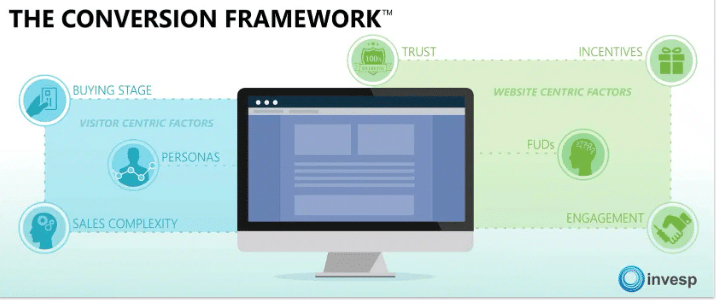
The Conversion Framework is built around seven principles:
- Trust and confidence (T)
- FUDs (F)
- Incentives (I)
- Engagement (E)
- Visitor persona temperament (P)
- The buying stage of visitors when they come to the site (B)
- The sale complexity (S)
With these seven elements, you can find out how visitors interact with your website and whether they are persuaded or discouraged to convert.
We like to break down the factors in the Conversion Framework into two different groups: website-centric and visitor-centric factors.
Website-centric factors relate to your website and how information is presented on it through design, layout, copy, and flow. These factors include:
- Trust and confidence (T)
- FUDs (F)
- Incentives (I)
- Engagement (E)
As you delve deep into CRO, you will discover that there are many techniques that you can use to accommodate and enhance website-centric factors.
Let’s take an example of increasing visitors’ trust and confidence in your website. How can you do that? You can use a strong value proposition, social proof, continue messaging and many other factors. As a matter of a fact, there are over 50 things you can implement on your website with the goal of enhancing trust.
How about reducing FUDs (fear, uncertainty, and doubts)? Again, there are many things you can do on a website to reduce FUDs. But it all starts with understanding the major concerns and anxieties visitors have when they visit your website or your competitors’ websites. When you have a list of the top FUDs visitors have, you address them through copy and design.
How can incentives increase your conversions? Let me first state that incentives go beyond discounting your offer. Selling your products or services at a lower price is rarely a good long-term strategy. The goal of incentives is to encourage visitors to act right away, as opposed to postponing the purchase, by thinking “I will come back to this website next week.” You can encourage your visitors through urgency and scarcity, for instance, instead of offering discounts.
Finally, there is engagement. If you are looking for a long-term relationship with your customers, you must move beyond a single conversion, into customer retention. Engagement involves surpassing customers’ expectations, by creating Aha moments. That is easier said than done.
Visitor-centric factors relate to the website visitor’s mindset and nature of the purchase. These factors include:
- Visitor persona temperament (P)
- The buying stage of visitors when they come to the site (B)
- The sale complexity (S)
You do not have control over these factors. That does not mean you ignore them. You have to accommodate them in your design, copy, and visitor flow.
By their nature, visitor-centric factors are more difficult to design for. They are more complex. That is the reason many conversion optimization consultants focus on website-centric factors. These tend to be easier to deal with.

Most marketers talk about personas and market segments. They know it all very well in theory. However, they fail in implementing it when they are designing their website or marketing campaigns.
Tech companies often fail at marketing because they take a fundamentally flawed approach to designing marketing strategy and campaigns. Subpar marketing leads to “me-too” uninspiring content on corporate blogs with insignificant social shares and superficiality from the target audience’s viewpoint. Tech companies struggle to create strategic messaging to describe their products and use undifferentiated messages, jargon and superlatives. The end result is that marketing drains significant resources on paid acquisition campaigns that have no market segmentation or designated landing pages.
Check Myk Pono’s How to Design Marketing Campaigns: The Importance of Market Segmentation
Not every visitor who comes to your site is ready to buy. Actually, studies by Invesp show that less than 20% of website visitors are in the action stage. Most websites focus just on these visitors, and ignore the remaining 80% who are interested in the products and services, but still unenthusiastic to make a purchase. However, visitors early in the conversion funnel should be addressed as well through copy and design.
Sale complexity, the final element of the Conversion Framework, deals directly with the nature of the item you are selling and how your prospect makes the decision of buying from you. To put things into perspective, consider the difference between selling t-shirts online versus enterprise software that costs millions of dollars. Your website and campaigns must account for both the complexities of selling your products as well as the many steps your visitors go through before making the conversion decision.
The following chapters in this guide go into details for each of Framework elements.
As you apply these principles to your website or campaign, you begin to see their impact. By implementing the science of online testing, you can measure the impact of any change you make on your bottom line.
Understanding the Conversion Rate Uplift Formula

The Conversion Framework Uplift Formula translates the different factors of the Conversion Framework in a formula you can apply to different pages on your website.
CRU = {3T-(2F-(I+E))] *B}^ (P * C)
This is not a mathematical formula.
This formula rather attempts to decipher human behavior on the web, recognizing which factors persuade visitors to convert on a website as well as which ones make them abandon the site.
Here are some notes you should keep in mind as you study this CRU formula:
- Each element in the Conversion Framework is broken into several sub-elements. The seven elements of the framework translate into close to 300 sub-elements to evaluate on a website.
- Trust (T) has the most impact on a visitor’s decision to convert. This makes sense. If the visitor does not trust the website, he will not buy from it. As you start analyzing your pages to determine what should be fixed on them, the first thing you look at is trust and its subcomponents such as value proposition, continuing in messaging, social proof and many others.
- FUDs (fears, uncertainties, and doubts – F) play a determining role in reducing visitors’ trust of the website by increasing anxieties.
- The best way to deal with FUDs is through incentives (I) and engagement (E).
- The buying stage (B) visitors come at impacts whether they will convert. Only 20% of your website visitors are ready to convert. The remaining ones are early on the buying process. That does not mean you should ignore them, you just need to design for them.
- The sale complexity (C) has a direct impact on the purchase decision. Some items are more of a considered purchase, while others are quick decisions. The more complex the sale, the more difficult it is to close.
- The visitor persona (P) temperament impacts how fast a visitor converts on your website.
Using the Conversion Framework during a CRO program
During one of our webinars, we presented the use of the Framework elements across different classes of webpages on a CRO program we ran for one of our clients. The video below will give you insights into how to use the Conversion Framework elements to see greater ROI.
So, how do you apply the Conversion Framework during a CRO project?
You go through several steps as you are optimizing your website for conversions. At a very high level these steps are:
- Conducting Heuristic Analysis
- Conducting Qualitative Analysis
- Conducting Quantitative Analysis
- Conducting Competitive analysis
- Creating Conversion Roadmap
- Identify Problems
- Use the Conversion Framework for assessing problems
- Prioritize Problems on the Page
- Create Hypothesis
- Create New Designs
- Conduct A/B Testing
- Conduct Post-Test Analysis
As you can see, the Conversion Framework is used in step 7 of a CRO system. Increasing a website conversion rate comes with a lot of complexities. If that were not the case, most websites would be converting at 20% and 30%, but average website conversion rates remain quite below this mark.
The next few chapters will introduce you to each one of the elements of the Conversion Framework and provide many examples on how to apply them while conducting a CRO project.